
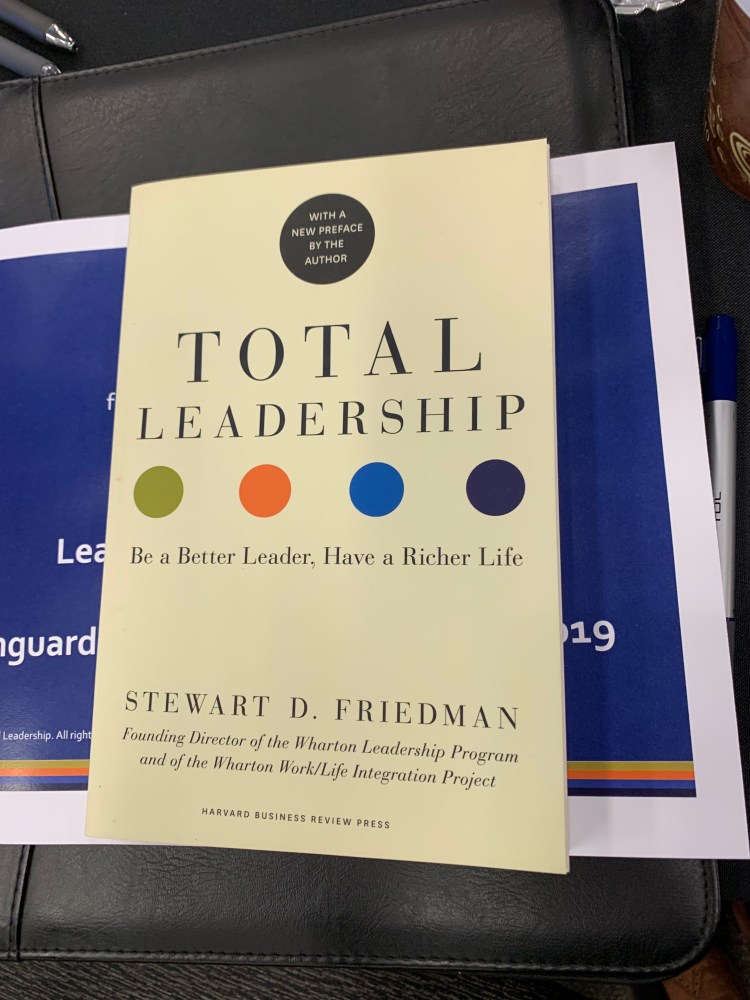
A few weeks ago, I saw Stew Friedman speak for the second time.
When I initially saw Friedman’s Work/Life Integration keynote at the 2017 Vanguard Leadership Symposium, I was a new leader, a new husband, and about to be a new homeowner. When I saw his keynote three weeks ago at the 2019 Vanguard National Sales Conference, I was a new internal sales consultant and a new dad.
A lot of change has happened since I last saw the Wharton professor speak. A lot of change is happening right now. A lot of change will continue to happen in the future. Life’s treadmill keeps on going and seems to increase the speed and incline at each interval. The treadmill belts keep running at home, at work, in our social community, and even in keeping up with personal health And wellness. If I try to simply balance all of the competing priorities, I’m essentially attempting to hop from moving treadmill to moving treadmill without stumbling.
Friedman argues that you can’t only balance these domains, but you must instead find a way to integrate them. This message came at a near perfect time…both times.
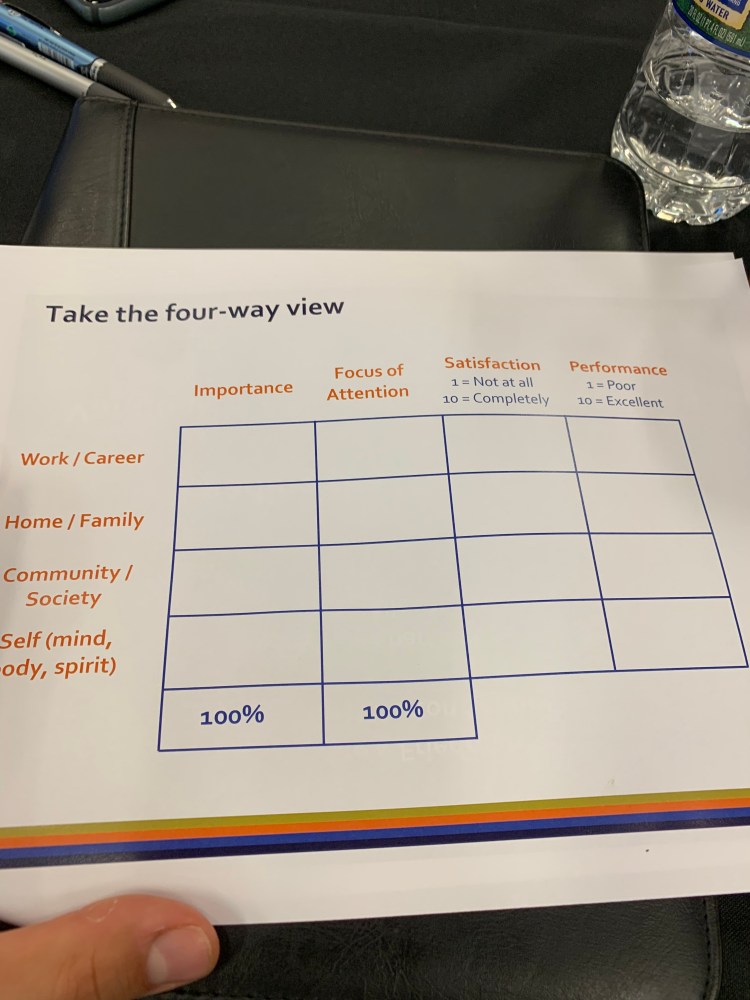
He led the audience through an exercise in which we took 100% of a pie chart, and divided it up across four domains based on their personal importance to us. The domains were:
1. Home (family, house)
2. Social/community (friends, community events/impact, network)
3. Career (current job, future development, additional education)
4. Self (health, enjoyment, personal time, hobbies, relaxation)
Once we allocated the percentages based on importance, he had us redistribute our percentages based on how we actually allocate our time/energy.
Many of us realized that we aren’t spending optimal energy on the things that we say matter most to us. For example, if we claim our home life is significantly more important to us than our career, why do we spend so much of our time at home stressing about our work week or the homework assignment for our masters program?
In some cases, we may underestimate how important certain domains actually are to our happiness. In some cases, we just struggle to effectively manage our energy, priorities, and expectations. But in most of these cases, we’re trying to balance all of the domains instead of creatively integrating them.
Friedman challenges us to find or implement experiments (4-way wins) in our lives that will integrate multiple domains at the same time.
After the first time going through these exercises two years ago, my 4-way win experiment led to the weekly reflection as it stands today. I hadn’t written anything in years, and Jordan was encouraging me to get past the writers block and get back into it. It was refreshing to take the time and reflect on the new life experiences I was facing at home. It was helpful to document what I was learning and new experiences I was having as a leader. I wanted to capture important memories with friends. Each week as I think about what to write, go through the writing process, and share the post with others, I feel more connected to my home, my social community, my career, and myself.
As I went through the exercises this most recent time, I came up with a new integrated experiment. I thought of the fact that a 10 year hiatus from the tennis court is long enough. I realize it can be a game to bond with Jordan and eventually teach Charlie. I imagine the fun future tennis events we could host with friends, family, and coworkers. Getting back onto the tennis court is my new 4-way win.
Now it’s your turn to go through the exercises. How would you allocate your “pie chart” of what’s most important to you? How do you actually spend your energy? How might you integrate all 4 domains? How might that change your life?
 The Janiec Reflection